
Inside the Data Room (Part I): The Key Files That Actually Close a Fundraising Round
The five folders every raise needs, the files inside each one, and why the data room (not just the deck) is where most rounds are actually won or lost.

I built an interactive data room into my own website. Not because it needed one, but because I frequently found myself explaining the same thing to founders over and over: what actually goes in a data room, in what order, and why the file inside each folder matters more than the folder name does. So I built the outline of the data room itself. Five folders, real file names, status tags and all. If you’ve clicked around jonathanhua.com/work, you’ve probably already seen it.
Here’s the version with the explanations attached.
A pitch deck is the version of your company you want investors to believe. A data room is the version that has to be true. Most founders spend three weeks on slide 7 of the deck and throw the rest of the data room together the weekend before diligence starts. That’s backwards, and it’s the single most fixable mistake I see in a raise. Nobody opens a cap table for entertainment. They’re checking whether the company they just heard about in the pitch is the same one sitting in the numbers. So let’s walk through the room, folder by folder, the way an investor actually would.
This is Part 1, and it’s deliberately about the core: the five folders that matter most and that any company, at any stage, needs to get right. I’ve written it with early-stage founders in mind, pre-seed through Series A, because that’s where most of you are and where the fundamentals get set. Part 2 covers everything a growth or late-stage company adds on top. But nobody should be adding the advanced folders until the core ones are clean, so start here.
01_deck: the story, with receipts attached
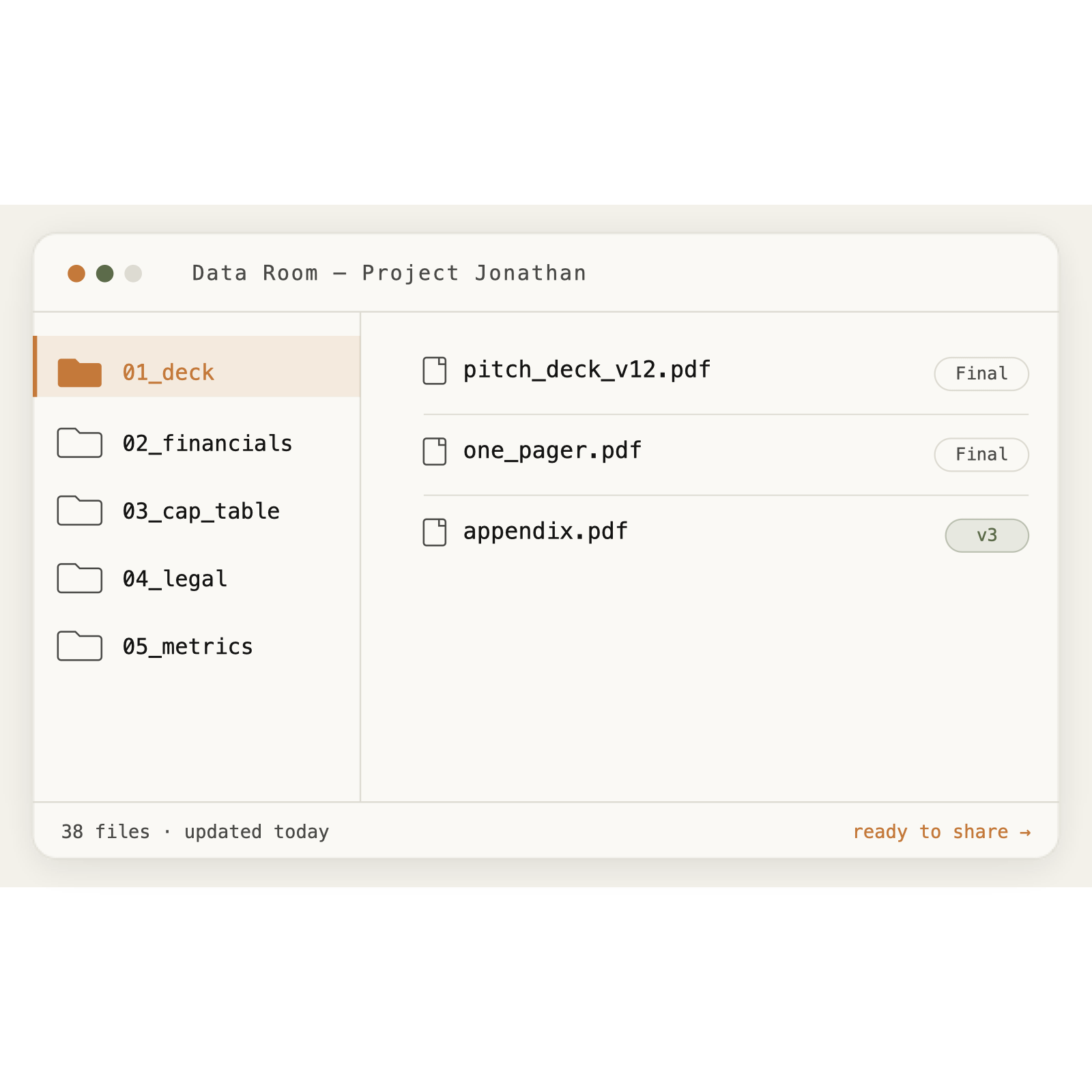
First thing worth noticing: it says v12. Not v1. Every founder’s deck goes through more revisions than they’d like to admit, and that’s fine. A deck that’s been stress-tested by twelve rounds of feedback is a better deck than one that’s never left PowerPoint. What’s not fine is when the version in the data room isn’t the version you actually presented. I’ve seen founders leave an older deck in the room because updating it feels like busywork. Investors notice. It reads as either sloppiness or, worse, as if the numbers changed and nobody wants to explain why.
The appendix is where the slides that would have made your deck too long go to live: the deeper competitive breakdown, the fuller market-sizing build (your TAM, SAM, and SOM, and yes, investors can tell when the top-down TAM number and the bottom-up SOM number were never reconciled with each other), the go-to-market motion broken out channel by channel, the technical architecture diagram nobody needed in the first ten minutes but somebody on the investment committee absolutely will ask about later. Sometimes this is included in the main deck as an Appendix section in the back, and that’s ok too.
The one-pager is optional, but “optional: doesn’t mean “skip it”. I highly recommend having one, but keep in mind that it’s not just a shorter markdown of the deck. It’s the thing that gets forwarded internally; to the partner who wasn’t in your pitch meeting, and to the associate deciding whether to take an intro call. Every venture firm makes decisions in a partner meeting you’re not in the room for. Your one-pager is what represents you in that room. If it’s bad, your story dies inside the firm before it reaches the people who’d actually champion it.
02_financials: where the story gets tested
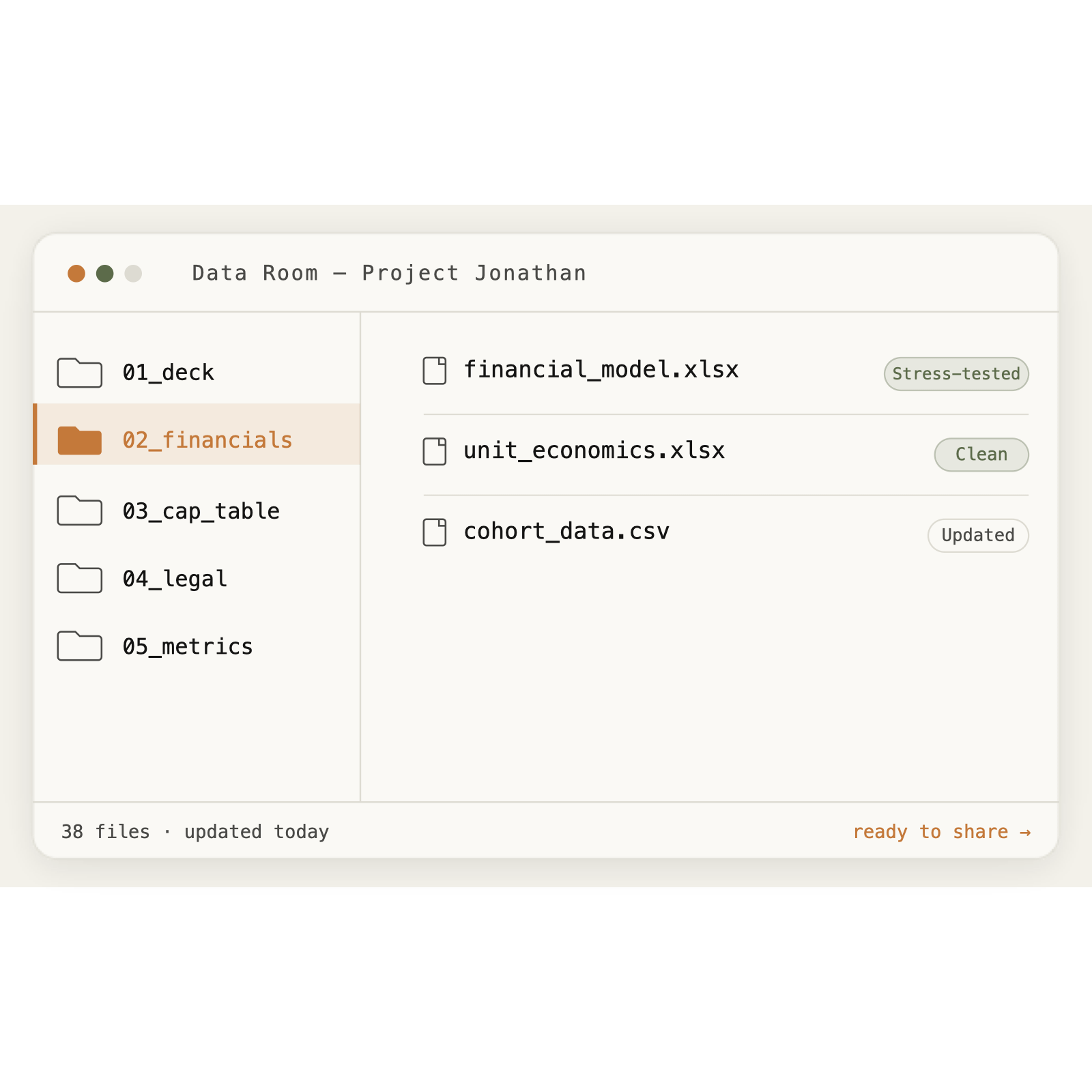
This is the folder where most first-time founders underbuild, and it’s the one investors spend the most silent time in. The model needs to be stress-tested, meaning someone (you, ideally, not just a banker or a hired analyst) has actually pulled the growth assumption down and watched what happens to runway (how many months of cash you have left at your current burn) and burn rate (how much cash you’re consuming each month). Investors will run these scenarios themselves regardless. The question is whether you already know the answer when they ask “what happens if you grow half as fast as this model assumes?”
At the early stage, your model is a projection, not a track record, and everyone knows it: nobody expects three years of clean audited history from a company that’s eighteen months old. But the assumptions underneath the projection are fair game, and a model that falls apart the moment someone questions a single input tells an investor more than the headline growth number ever could.
Unit economics deserves its own file, separate from the model, because it answers a fundamentally different question: not “will this company grow,” but “does growth make the company more valuable or just bigger.” This is where the real vocabulary lives, and it’s worth being precise about it:
CAC (Customer Acquisition Cost): the fully loaded cost (sales, marketing, the people and tools behind them) to win one new customer. Not just ad spend. The number founders quote is almost always too low because they forget to take wages, salaries and other overhead costs into consideration.
LTV (Lifetime Value): the total gross profit you expect from a customer across their entire relationship with you. Note gross profit, not revenue: a common mistake is computing LTV off revenue and quietly inflating it by your entire cost of goods.
LTV:CAC Ratio: how many dollars of lifetime value you get for every dollar spent acquiring a customer. Investors generally want to see a path to 3:1 or better. Below 1:1 means you’re literally paying more to acquire customers than they’re worth, which is a machine for lighting money on fire.
Payback Period: how many months of gross margin it takes to earn back the CAC. Twelve months or under is strong for most early software businesses; the longer it stretches, the more cash you have to float before a customer becomes net-positive.
Gross Margin: revenue minus the direct cost of delivering the product, as a percentage. A “software” company running at 40% gross margin is telling you it isn’t really a software company underneath, and investors will price it accordingly.
Cohort data is the one that’s genuinely nice-to-have at the earliest stages and increasingly non-negotiable the further along you get. A cohort is just a group of customers who started in the same period (i.e. everyone who signed up in July) tracked over time. Cohort analysis is how you tell the difference between a business that’s growing because it retains and expands what it wins, versus one that’s growing only because it’s pouring more into the top of the funnel while the bottom quietly leaks. At minimum, it’s proof that retention isn’t a story you’re telling, it’s a pattern you can show.
03_cap_table: the cleanliness test
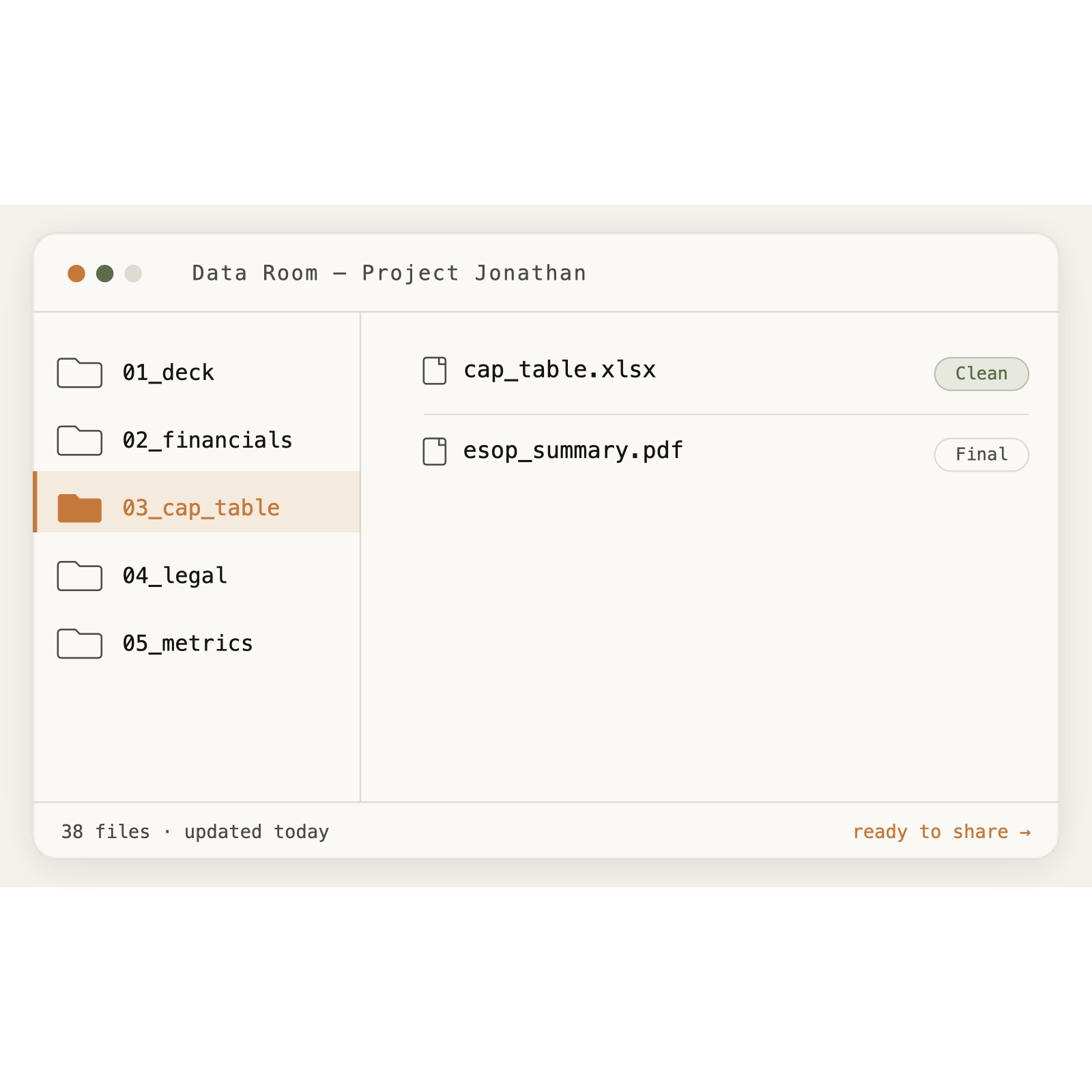
Notice the status tag here is simply “Clean.” That’s not a throwaway label: a messy cap table is one of the fastest ways to slow down or kill a round, and it’s almost entirely self-inflicted. Convertible notes that never converted properly, SAFEs with inconsistent terms (a SAFE, Simple Agreement for Future Equity, is the standard early-stage instrument that converts to shares at your next priced round; simple in theory, messy in practice when you’ve signed a dozen with different valuation caps and nobody’s tracking what they’ll convert into), advisors who were promised equity in a Slack message and never got paperwork. None of it is fatal on its own. All of it adds weeks to diligence and, worse, makes an investor wonder what else in the room hasn’t been kept up.
What an investor is actually checking here is your fully diluted share count. Not just the shares issued today, but everything that could convert into shares: the outstanding options, the unissued option pool, every SAFE and convertible note. Founders love to quote ownership percentages off issued shares because the number looks better. Investors do the math off fully diluted because that’s what they’ll actually own after everything converts. The gap between those two numbers is where a lot of first-time founders get an unpleasant surprise about their own dilution.
The ESOP summary is where founders either show they understand their own option pool or reveal they’ve never actually looked at it. ESOP stands for Employee Stock Option Plan, the pool of equity you set aside to hire and retain your team. How much is allocated, how much is left, what the strike prices look like; an investor evaluating a round needs to know whether the pool needs refreshing (topping up) as part of the deal, and here’s the part that stings if you don’t see it coming: a pool refresh usually comes out of the existing shareholders’ ownership, meaning yours, before the new money comes in. Understanding that going in means you can negotiate it. Getting surprised by it means you negotiate it badly.
04_legal: the folder nobody wants to build and everybody needs
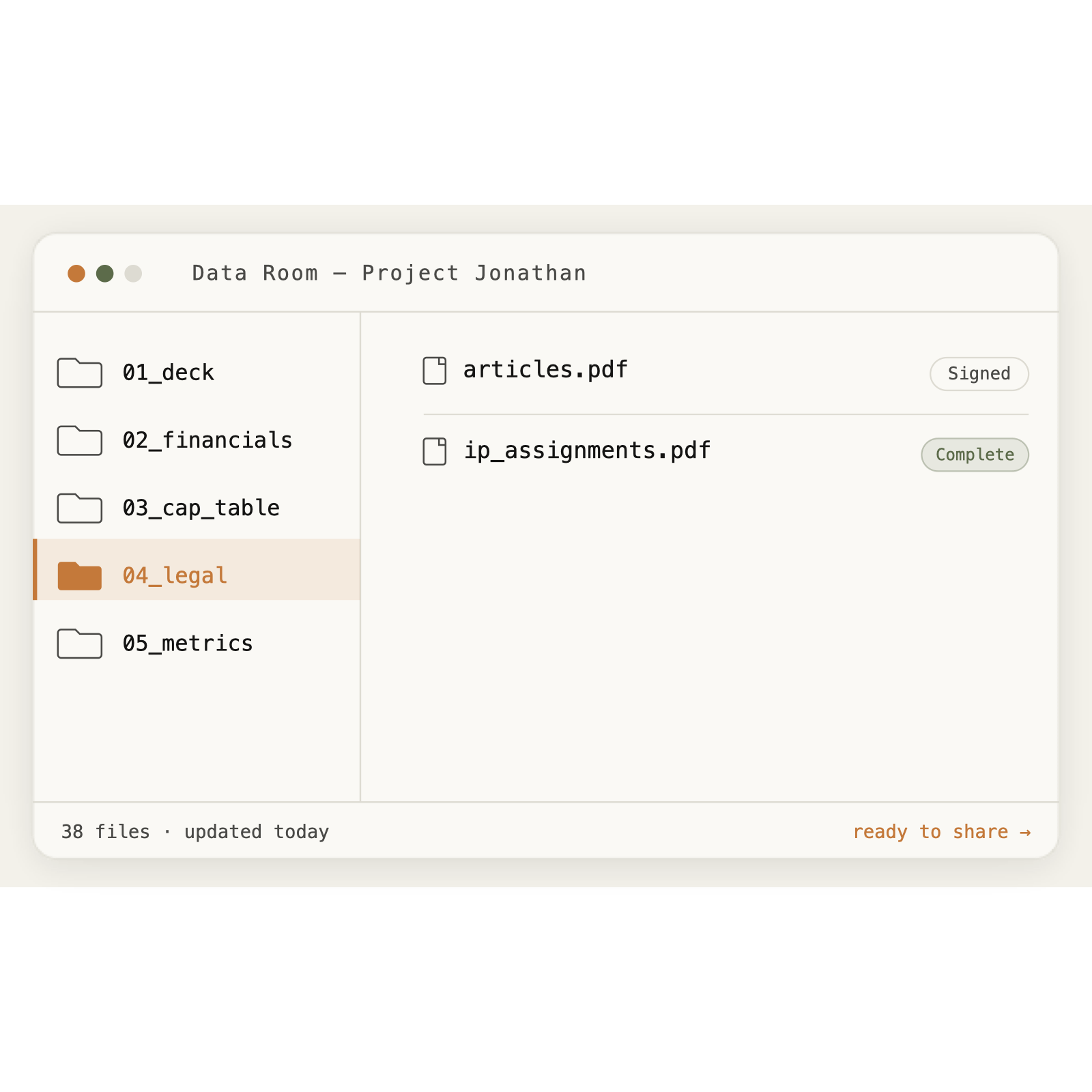
Articles of incorporation being marked “Signed” seems almost too basic to mention, except that I’ve watched rounds stall because a company’s foundational documents were technically incomplete: an amendment that never got filed, a state registration that lapsed, a Delaware franchise tax nobody paid. It’s boring. It’s also table stakes, and the fact that it’s boring is exactly why it gets neglected.
IP assignments matter more than founders expect, especially for anything technical. An IP assignment is the document that transfers ownership of intellectual property (code, designs, inventions) from the individual who created it to the company. If a co-founder, an early contractor, or a friend who “helped out for a few weeks” wrote code or built something that ended up in the product without a signed IP assignment, then legally, the company may not actually own its own product. That’s a real gap an investor’s counsel will find, and it’s a much cheaper problem to fix at incorporation than to untangle three years and two rounds later when the person who wrote your core module is unreachable or unhappy.
Early on, articles and IP assignments are close to the whole folder, and that’s appropriate. This is one of the folders that grows the most as you scale (Part 2 covers what gets added), but the foundation being genuinely clean matters at every stage, and it’s easiest to get right when the company is small.
05_metrics: the one that has to stay honest
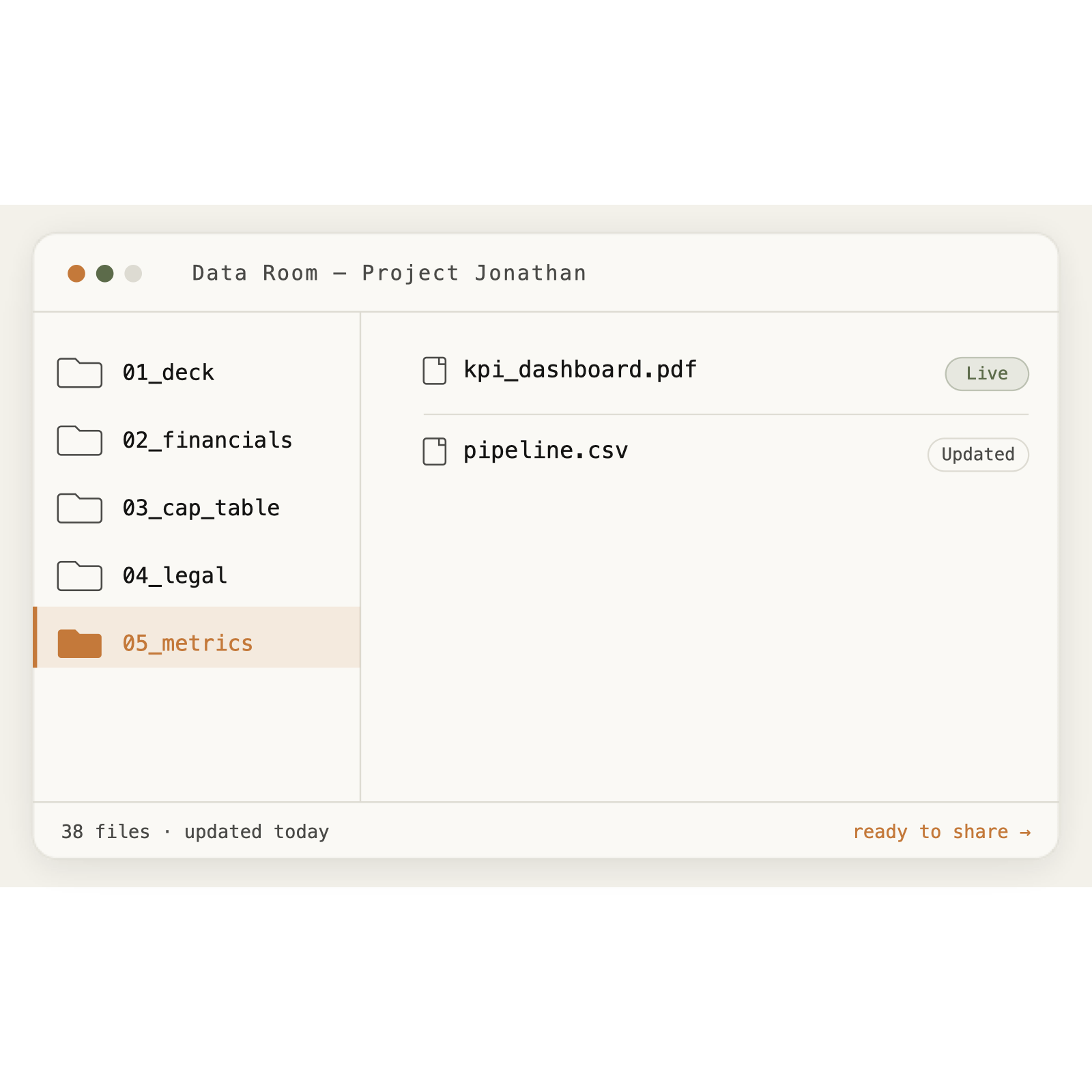
“Live” is doing real work as a status tag here, not just as a design flourish. A metrics dashboard that was accurate three months ago and hasn’t been touched since is worse than no dashboard at all, because it invites the obvious question: why hasn’t this been updated, and what changed that you’d rather not show? The fix isn’t complicated. It’s just discipline.
At the early stage, your KPI dashboard should show whatever your real north-star metrics actually are, presented honestly: active users, activation rate (the percentage of signups who reach the moment where they actually get value from the product), month-over-month growth, early retention. You don’t need the full late-stage metrics vocabulary yet (that’s Part 2), but you do need the numbers you do have to be real, current, and consistent with what’s in your model and your deck. The single fastest way to lose an investor’s trust is a metric that says one thing on the dashboard and another thing in the financial model.
The sales pipeline is your list of prospective deals and where each one sits in the process. At pre-seed, growth is a hypothesis, and the pipeline is mostly a signal of demand (i.e. are people actually trying to buy this?). By Series A it starts becoming evidence of a repeatable motion.
Where the room lives at the early stage
One thing nobody tells first-time founders: the platform your data room lives on is its own decision, and at the early stage it’s a much simpler one than people make it out to be.
At pre-seed through Series A, a well-organized Google Drive or Dropbox folder is completely fine. I’ve seen plenty of clean, fast, successful early-stage raises run entirely out of Drive. Nobody is judging you for not paying for enterprise software when you’re an eight-person company. What actually matters at that stage is the organization inside it: consistent file naming, a clear folder structure that mirrors what we just walked through, and permissions that don’t accidentally give a prospective investor edit access to your cap table (set everything to view-only, and share folders, not your entire Drive).
There’s a whole world of dedicated virtual data room platforms, like Intralinks and Datasite, with version control, granular per-user access, watermarking, and audit trails. They’re genuinely valuable, and they’re also genuinely unnecessary at the early stage. Using one at pre-seed would be like hiring a law firm to draft your roommate agreement. I’ll cover when that shift actually makes sense in Part 2.
The thread that ties it together
Every folder in this core room is answering the same underlying question, just from a different angle: is the company in front of me the same company on paper? The deck tells investors who you say you are. The financials show whether the growth is real and whether it makes the company more valuable or just bigger. The cap table shows whether you’ve run a tight operation or a messy one. The legal folder shows whether the foundation is actually solid or just looks that way from the pitch. The metrics show whether you’re willing to let them see the truth in real time, not just the truth as of your last board deck.
Get these five right and you’ve built a room that can carry an early-stage raise. Build the room like someone smarter than you is already inside it, because by the time it matters, they are. A pitch deck earns you a meeting. A data room earns you the wire.
Next week, in Part 2, I’ll walk through what a data room grows into: the additional folders (product, commercial, regulatory, and more) and the heavier financial machinery (Adjusted EBITDA, free cash flow waterfalls, net revenue retention, the rule of 40) that growth and late-stage investors expect once you’re asking them to underwrite an outcome instead of a story. The core stays the same. The room around it gets a lot bigger.